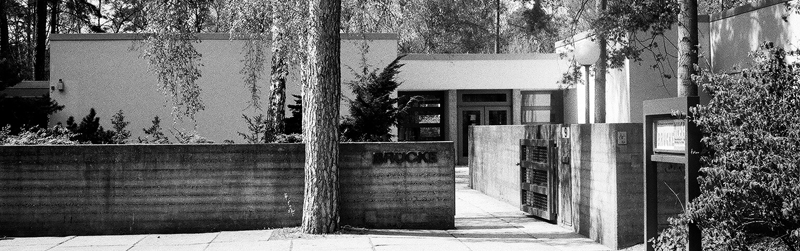
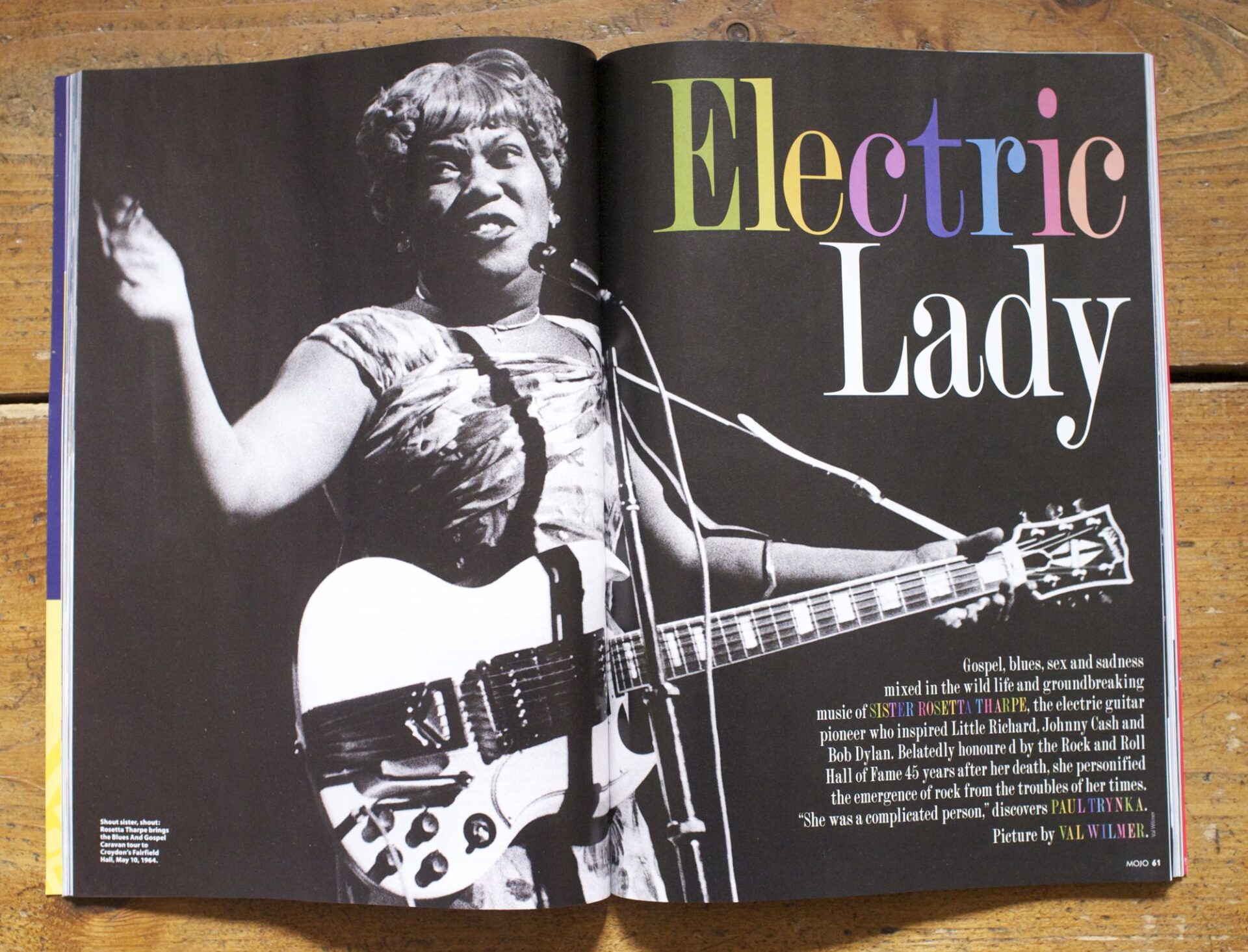
This week I noticed the site where Sister Rosetta walked out in furs, wearing a Gibson SG, is being commemorated with a blue plaque. Hence the return of this story from my old site. Thanks to MOJO for their co-operation in my reprinting the story. The copy here might not be the final draft – buy the issue for the real thing!
Music, no less than religion, eternally promises the triumph of the lost, the downtrodden, the mistreated Other. And that promise was surely never fulfilled with a greater triumph than the rainy evening in late Spring 1964, that Sister Rosetta Tharpe, in red wig, bejewelled white fur coat and gold-bedecked Gibson SG walked out onto a train platform electrifying, not just an audience, but a world. A seven minute clip of that performance is the ultimate evocation of how the outsider can finally triumph. Today, the mainstream has finally claimed the Sister, via her induction to the Rock and Roll Hall of Fame. Yet still, Rosetta’s rollercoaster, topsy-turvy life, spent negotiating the frontiers of race and sex, shows she is Otherness incarnate.
Rosetta Nubin’s birthplace in 1915 was Cotton Place, Arkansas. It was the landlocked location of parched cotton fields, mid-way between heaven and hell: a place where religion promised one of the few escapes from everpresent dixie repression, after southern whites wiped out African Americans’ post-Reconstruction civil rights. Even the churches were racially split: which would have huge repercussions for the central figure throughout Roberta’s life: her mother, Katie , aka – “Mother” Bell, who according to their friend, the distinguished writer and producer Anthony Heilbut, was “was almost from the 19th century, in the way she carried herself..”
Mother Bell was a travelling evangelist, and musician, for the fast-moving Church of God In Christ, the Pentecostal church which had split from its white brethren they year before Rosetta’s birth. Her much-loved Rosetta would become her child prodigy, singing, dancing, playing guitar and piano by the age of five or six. Mother Bell’s travels paralleled that of her church, which expanded from the racist south to the burgeoning North, inspiring her move from Arkansas to Chicago in 1921. The church’s heady mix of spirituality and showbusiness suffused mother and daughter, in different ways, for as Heilbut suggests, “Mother Bell was really an old time saint. Which is funny as Rosetta was was in many ways, so very worldly.”
It’s possible Rosetta was exposed to blues or jazz in the Northern cities. Yet it was churches, not clubs, where she was schooled, for the Church Of God In Christ, aka COGIC, was fast becoming a cultural powerhouse. Its churches were sophisticated, commercial organisations, and music was a well-proven technique to deliver an intense, irresistible rush of euphoria that would have the audience speaking in tongues. COGIC’s rise to become the leading Pentecostalist organisation was powered by hugely popular musicians like pianist Elder Charles Beck and guitarist Utah Smith (who performed wearing giant angel wings). COGIC’s Chicago church dwarfed most of the city’s venues. Crucially, says Heilbut, the Church took a special interest in talented multi-instrumentalist kids: “they had these wunderkinder who could play piano guitar and horn and could sing. All these tremendous talents were there when Rosetta was coming up, she’d be learning from them and interacting all the time.”
Although separated, psychologically, from secular, especially blues music, Pentecostal church music was every bit as competitive and extravagant, driven by intensity and volume.This separation explains why her guitar playing, especially, exists in a space of its own, with few apparent influences from contemporaries. Her distinctive mix of chording, single note and two note runs is cross-cultural, like Lohnnie Johnsons’s early work, the only obvious antecedents being distant ones, like Blind Roosevelt Graves. We don’t know if Rosetta had much regular schooling – although she was literate, unlike her friend and contemporary Marie Knight – but music became that focus of her whole life, always encouraged by her mother. “Whatever hours Mother Bell wasn’t working to support Rosetta were spent in church,” says Heilbut. Many of her contemporaries were forced into “rough labour,” he explains. “It’s possible she never did. Which would make her a blessed child.” Instead, her childhood and teens were entirely focused on church – and music. Her immersion in COGIC was like a 24-7 Brits Academy – only a moving academy that toured from one musical hotspot to another.
Touring COGIC venues with her mother, the wunderkind carved out her own sound, always state of the art. Although she’s often mistakenly credited playing with electric guitar in the 30s, like many blues guitarists Rosetta switched early on to a steel resonator guitar for increased volume. Her piano-playing was just as important: “Athe house she seemed to have more fun with the piano.”
The church’s febrile intensity influenced more than Rosetta’s playing. It defined her sexuality, too. Heilbut: ‘Rosetta once told me, “I was a good girl in Cotton Plant. [But] when I moved to Chicago they turned me every way but loose.” You know how old she was when she hit Chicago, at Robert’s Church? Five!” We don’t know exactly what Rosetta was exposed to, but it meant that “[Rosetta] had a very rough edge.The description of her as maternal is misleading, she was very funny but also could be very rough.” Gospel-infused places were very worldly. Even within that world, Heilbut remembers Rosetta as “one of the most sexual women I ever met.”
Little is known of Rosetta’s first marriage, age just 19, to the Reverend Tommy Tharpe. It’s suspected he was a philanderer, or abusive, and their time together was brief but her performances with him around COGIC’s church in Miami proved a stepping stone to her big breakthrough in New York, including an appearance at the first of John Hammond’s Spirituals to Swing showcases, in 1938. The recording of her with boogie-woogie pianist Albert Ammons, a rocked-up supercharged version of Washington Phillips’ That’s All, proves her poised for crossover.
This was the year that Robert Johnson was sought, but unfound, and when Charlie Christian emerged to fame. Rosetta’s rise was just as vertiginous: partnerships with the Cab Calloway orchestra, and Lucky Millinder launched her to superstardom. Recordings like Rock Me, with Millinder, and 1944’s immortal Strange Things Are Happening Every Day, with pianist Sammy Price, were true crossover hits, embraced by white as well as black audiences. There’s speculation Rosette was troubled by the secular nature of some of the material; that seems implausible, given her love for showbusiness, and her hard-won knowledge of how to move new crowds: “she had come from churches where people was rock and rolling – moving to the Savoy ballroom, it was like the secular version of what she’d done already,” reckons Heilbut.
In an understandable reaction to her later obscurity in the US, it’s been suggested Rosetta was ignored or patronised, as a woman guitarist. Doubtless, there was sexism and misogyny both in the music and church business; Rosetta had to be tough, like her secular peer, topselling blues guitarist Memphis Minnie. But her glamour underpinned half a decade’s worth of hits; she had a strong following in New Orleans, home of the camp, influencing Little Richard and gospel-infused performers like Guitar Slim, while Johnny Cash was another self-avowed fan. Even within the church, her otherness brought her a committed gay following, Anthony Heilbut believes.
By 1946, Rosetta was in control of her own sound, as she formed a duo with her friend, sometime lover, and fellow COGIC prodigy Marie Knight; their brief affair reinforces Rosetta’s status as an icon of Other-ness. Simone de Beauvoir defined a woman as the key Other – Tharpe’s race, her sexuality, her white SG, surely takes her Otherness to a higher order. But she transcended labels. Her sexuality wasn’t binary, she simply took love where she could get it, says Heilbut: “I tend to say, Rosetta worshipped at the church of Whosoever Will. She was a complicated person.”
The black – “Race” – music scene was moving fast by the early ‘50s, with older musicians rapidly supplanted. Rosetta fended off the inevitable with a sensational coup de theatre in 1951, teaming up with Washington promoters Irvin and Israel “Izzy” Feld to sell tickets to her latest wedding at Griffith Stadium, presided over by a COGIC pastor. Decca’s press release claimed 20,000 attended. Perhaps Rosetta craved the fame rather than the husband: the man in question, Russell Morrison, took over management. In circular logic, he is usually described as “not as bad as he is described.”
The husband slash manager hardly revitalised Rosetta’s career; her recordings for Mercury in the mid 50s are pleasant, but hardly registered with the public. Yet an unthinkably magnificent second act was about to beckon.
* * *
Bandleader Chris Barber had already midwife’d British rock’n’roll, via his co-invention of skiffle with Lonnie Donegan in July 1954; he was a champion of black R&B too, bringing over Big Bill Broonzy, Muddy Waters and, in November 1957, Rosetta, for a British tour. She wasn’t a supporting act: she was the main attraction, and took to it as if this strange turnaround was the most natural thing possible: “She had no doubt. She believed in herself,” says Chris. “And so she [carried it off]. People were convinced.”
As unsettling as it should have been, performing in another continent, it wasn’t. She enjoyed it. In some areas there was mutual incomprehension: “I remember her saying, the moon draws water from the sun. I couldn’t understand some of her beliefs, yet she was entirely genuine,” says Barber. Yet, she was at one with Barber and his musicians, heard and enjoyed every note, and although she found it necessary to travel with Russell “as a protector,” says writer and photographer Val Wilmer, she seemed utterly at ease with every aspect of this strange universe. Apart from the food. “I was with her when she and Russell had lamb chops delivered at her hotel,” Wilmer remembers. “She poked hers around the plate, and said “these aren’t like we have at home. At home we have seasoning.”
In Rosetta’s trips of 1957 and1958, one trait inspires anecdote after anecdote: “her generosity,” says Wilmer. “In every respect, with material things, and with advice. She liked to give both. I don’t think people resented it; most people had never met anyone like that.” Rosetta tutored Barber’s wife and singer, Ottilie Patterson, decided Barber’s band needed a decent haircut – which she duly administered – and encouraged photographer Terry Cryer to marry his girlfriend, Anne, funding their honeymoon and acting as Maid of Honour. “She was looking out for people,” says Barber.
Although US sales were by now a thing of the past, Europe continued to embrace her. Of several subsequent tours, one has become immortal, a packaged event with Muddy Waters, Otis Spann and other titans, that resulted in the electrifying footage of Rosetta in furs, backed by a hot band including pianist (and ex-Bechet sideman) Cousin Joe Pleasant.
Since the footage was ‘liberated’ from Granada, it has become iconic, a Youtube staple. It also felt that way for those involved: “It was remarkable… fabulous,” says Johnnie Hampton, the producer who sold the concept to Granada, and pushed through the herculean task of finding crew, building the set, and even navigating the train timetable (although the Chorlton-cum-Hardy station was disused, the line was still active, with trains hurtling through at 60 miles per hour. Fortunately they kept to schedule).
The show was “hard work”, with new experimental techniques such as radio transmitters and lapel mics so the performers could move more or less freely. Yet truly the hardest work was that of Rosetta and her fellow musicians, navigating this surreal cross-cultural journey with style and impeccable musicianship. “The professionalism of the artists was tremendous… considering the rhythm section surely could hardly hear,” says audience member , blues guitarist Dave Lunt. “The gig was outrageously good. It wold live in the memory even without the tape.”
Legend has it that Rosetta decided to play Didn’t It Rain once the Mancunian drizzle commenced shortly before the 7.30pm start, but according to Hampton it was planned anyway, simply switched from later in the set to the opener. But the rain forced a wardrobe revision, with Rosetta opting for the coat, of short white fur, over her expensive dress. The combined effect of jewelled coat, red wig, and dazzling white Gibson SG custom was awesome, fans remember, outdone only by the sound: “it made more of an impression on me than Hendrix did all these years later,” says Lunt. “It was simply outrageous, with a phenomenal sound – a good amp, Vox AC30, working well. You wonder how she had the energy, after all those years, to sound like that.” As Lunt points out, the sound is unique in space and time: “It was coming from another place, then,” says Lunt. “ And still sounds like that to me now.” The full-length show at the Free Trade hall was, says photographer Brian Smith, who saw both, “even wilder.”
It was a glorious Indian Summer, but it wasn’t without its sadness. Rosetta missed her mother, and she missed the acclaim in her homeland. Mother Bell, Rosetta’s lifelong confidante, died, leaving her distraught, and shortly after she lost a foot to diabetes. By now, longtime friend Heilbut had produced several successful gospel sessions, and pushed for a new deal. “I had to beg Savoy Records to give her a thousand buck advance. If she had had a few more gigs, and record sessions… it sure would have helped.”
Heilbut’s recollection of Rosetta’s life as a star-crossed one is surely tinged by the awful fact that Rosetta died the day she was scheduled to start the album he’d mapped out for her: “I don’t want to be overblown… it was one of the saddest days of my life.”
Revered in Europe (and a cover star for MOJO’s Guitar Greats issue), Rosetta finally acquired the adoration she craved in her homeland via a plaque on her grave in 2011, and induction to the Rock and Roll Hall of Fame this December last. The accolade is accurate but incomplete. She’s described as a guitarist, “but in many ways her piano skills were more advanced,” says Heilbut. She’s described as an architect of rock’n’roll, when really she transcends genre. She’s described as the Mother. Yet, in her furs, her wig, her sophistication and her abandon, Rosette will always be the Glorious Other.
Leave a Comment