I’ve lost too many people to death over the last 10 years, as most of us have. Some are more awful than others. Some, for me, trigger a kind of contradictory satisfaction: that the individual lived their life well to the end, they were in control and they knew they’d achieved meaningful things. When I heard David Bowie had died via a phone call around 6 in the morning I felt an almost indecent emotion: admiration.
It was George Sims who told me, not far off 20 years ago, how David Bowie had a ‘superior degree of control’. I felt that during David’s disappearance, when he was nestled in Lafayette Street, a little like Don Delillo’s mysterious protagonist in Great Jones Street, a novel set right around the corner. It was a supreme act of theatre, as suggested by Julien Temple, who thought that Bowie had long been pining for ‘that Houdini mechanism’, a dramatic disappearance like something out of The Prestige movie. My January 11, 20 years ago, was full of those thoughts. I was thinking about Lexi, who didn’t have a dad and how awful that was for her, David and Iman. I was thinking about Donny McCaslin telling me, just a few days before, how when David recorded he was so ‘present‘ – in the room, experiencing the moment, to an epic extent. But I was also thinking of how satisfied David would have been, completing Lazarus and Blackstar and thinking at the end, Job’s a Good Un.
George Underwood was one of the first people I went to see, to try and process all those thoughts you have, when someone you’re connected to leaves for the ultimate New Career in a New Town.
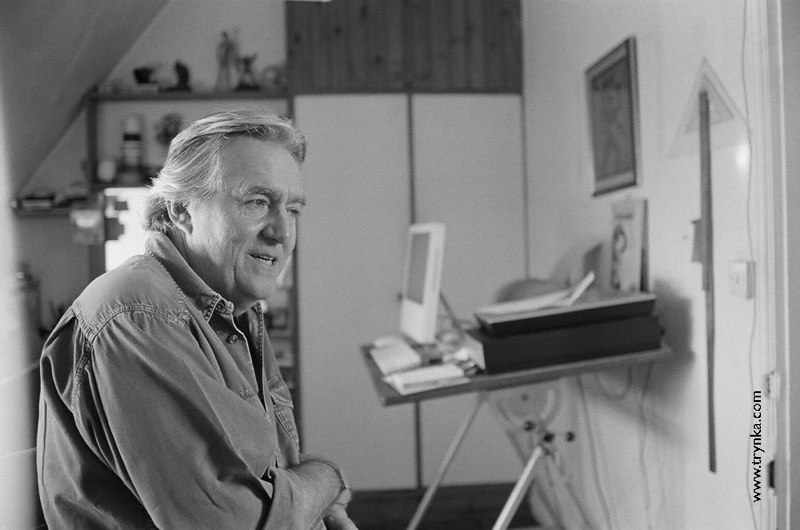 When I researched Starman, I was exceptionally lucky to speak both to enemies of David Bowie – for instance, ex-wife Angie – and friends. I felt especially lucky to speak to George Underwood. Balance is a hard thing to achieve in a biography… I felt George helped me hugely, in that balance of praising talent, the ambition, and reconciling it with a degree of selfishness – David’s attitude of “Numero Uno, Mate!” George helped me calibrate. More than that, though, George is a kind, un-neurotic, generous man, who has continued a successful career as a visual artist in his own right. Hence, when David died, and I felt the need to simply talk about him as a person, George was the first person I thought of.
Hence we spent a lovely morning, on a crisp, bright English spring day, talking about George’s missing friend. We discussed how David told some people what was going on, on a strictly Need To Know basis. It brought to mind something George Simms told me: that David had “a superior degree of control.” Didn’t he, just.
You said to me once that David had lived life wrong way around.
When Joe was born, it was just after [Birgit and I] got married, I think he was happy to be a dad but his career was taking off ridiculously. I think he regretted not being around for Joe – who we never called Duncan in those days. Later there was a time when Duncan didn’t know what he wanted to do. I could see how happy David was that Duncan found his niche and got succes, it was great. Then Lexi came along and he became a dad for the second time. I wonder what life was like. [In] New York I read he was left alone and could walk around the streets on his own. I didn’t see him much over that time but I’m hoping he was doing all the things you do as a dad, that he didn’t get to do with Duncan.
Even when David knew he was ill, he chose to work. That reminds me of stories going right back to the Manish Boys – of how you could rely on him. He’d always turn up for work – unlike so many musicians!
He knew how to go out and when to stay in. And get things done. When I’m painting, if you’re on a roll something happens, you feel someone else is doing it for you and I think writing songs, with David, if you imagine him in the middle of writing Life on Mars, the phone is ringing, and he’s, I can’t [answer], I’m writing. You need a certain concentration and focus for the thing that makes it magic, that lifts it above everyone else’s work. Because it’s there waiting, that chord or line is waiting, that mark on the canvas, that lyrics, that will be so much better. And that’s something David wanted, to get just better than the next person. He wanted people to listen to this, and for people to go, Wow. Not just, that’s OK, That’s good. You have to hate it or love it. And I think David stood by that. To rise above everyone else’s .
It’s rare to see such a lack of self-pity.
It was very good, wasn’t it? You have to admire his tenacity. He wasn’t… it was 18 months they say… I don’t think you can create in pain. He must have been okay, to be able to do it in the studio and do things. The chemo couldn’t have been pleasant. How he managed to do that is extraordinary.
I find that quite profound. To get on with the business and find a spirituality in the work.
Exactly right. And I like the way he left all these clues . David was a bit of a windup merchant, he liked to leave these clues for people to work out. I look at the back cover of that Mercury album, what’s the fish doing. I don’t know! His idea was perhaps that the world is going downhill with pollution. He wasn’t specific. He liked leaving unanswered questions. And didn’t he do that with the last video superbly?
I love the quote in I Can’t Give Everything Away: it’s a snippet of A New Career in a New Town? What a brilliant way of describing that last journey!
Nicely put. I can’t better that.
You didn’t have an inkling, did you?
No. I was looking through the last emails we exchanged. It was quite funny, he used to send a hamper to me and Geoff [MacCormack] every birthday, and I made a little video of my wife and I with the hamper. I’m saying Thank you David. He emailed back to say, You look like your dad. I said to him, I look in the mirror and keep seeing my dad. He said, I look in the mirror and I keep seeing your dad as well!
I knew he was working on an album. We used to send each other funny things and I didn’t have anything funny to send him. And I regret that now. I wish I had.
I was checking the emails he sent. This was about a year ago. He bought a painting off me. I said you’re a star. And he sent a note back, saying, Yes, I know.
I feel his disappearance somehow underlined that, This is the most fundamental rite of passage.
Exactly. And nowadays you don’t get much chance to say goodbye properly. David did it well, in an excellent way. I don’t think anyone else has done anything like it.
Note: these photos of George are a few years old, as my old camera developed a fault the morning I saw him. But then again, the man looks just the same today.
Leave a Comment